
Ryanair Customer Portal
- Aug 17, 2024
- 5 min read
Updated: Aug 17, 2024
Problem Statement
One of the main areas of customer dissatisfaction is the customer service experience. Customers have reported that they often receive unclear or ineffective responses, face difficulties in getting in touch, and cannot access support on weekends due to limited operating hours. To address these issues, the product team aims to offer self-service tools that enable customers to resolve problems or inconveniences intuitively through the website and app, eliminating the need to contact the customer service center.
Project Goals
Develop the necessary functionalities for customers to resolve their issues independently through digital channels.
Ensure these functionalities are easy to access, discoverable, and intuitive to use.
Team Structure
4 Product Managers
1 Associate Product Manager
Head of Product
Director of Marketing and Distribution Partnerships
Director of Brand Marketing and International Communications
Brand Manager
Market Research Manager
Chief Marketing Officer
2 UX Designers
1 UI Designer
1 UX Researcher
UXR Methods
Method | Objective |
Metrics analysis | Identify the most top drivers’ customers contact the service center, using data from the CS management platform, Zendesk. |
Surveys | Gather detailed insights on customer satisfaction regarding specific issues, frequency of contact with CS, other means of contact, resolution status, and time. |
Interviews | Engage with customers who have had specific experiences to understand the problems they faced, their expectations, and the actions they took to resolve them. |
Competitor analysis | Review what manage functions other low cost airline are offering through their app and website, and explore how they worked them out. |
User testing | Identify usability issues in existing web, mobile web, and app functionalities. Test new proposals before handing them off to the DEV team to ensure a high-quality MVP. |
Heuristic evaluation | Detect usability and accessibility issues in existing functionalities. |
Journey maps | Map the actual user experience based on interviews, focusing on the specific problems encountered by users. |
Process
My process generally follows these stages: Define, Ideate, Prototype, Build, and Analyze. Here’s how I applied it to the Customer Portal project:
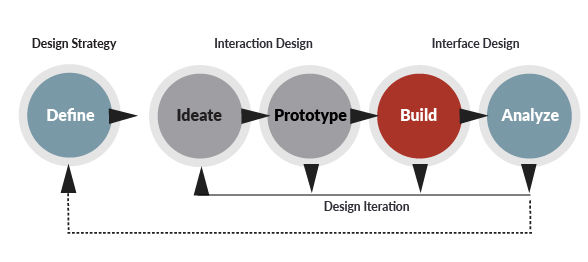
1 - Define
We began with an internal workshop where we shared existing knowledge and identified gaps in our understanding. Using regular reports from the Customer Service team, we pinpointed the most common reasons customers contact us. We also supplemented this data with insights from our CSAT survey to gauge customer satisfaction with problem resolution.

Simultaneously, the Product team compiled a list of features currently available through the website, mweb, and app, alongside those that are not yet supported. This exercise helped us create a backlog of functionalities to be developed.

We divided these functionalities into two main categories: existing and non-existing:
Non-existing functionalities required a strategic design approach, starting from the definition phase, which involved conducting interviews and creating journey maps.

Existing functionalities required an iterative design approach, beginning with the analysis phase, which included usability tests and heuristic evaluations.

For non-existing functionalities, I conducted semi-structured interviews to explore customers' expectations and perceptions. I was particularly interested in understanding the solutions customers envisioned, where they expected to find them, what these solutions would look like, and their initial actions and expectations. The interview questions were tailored to the specific functionalities under investigation.


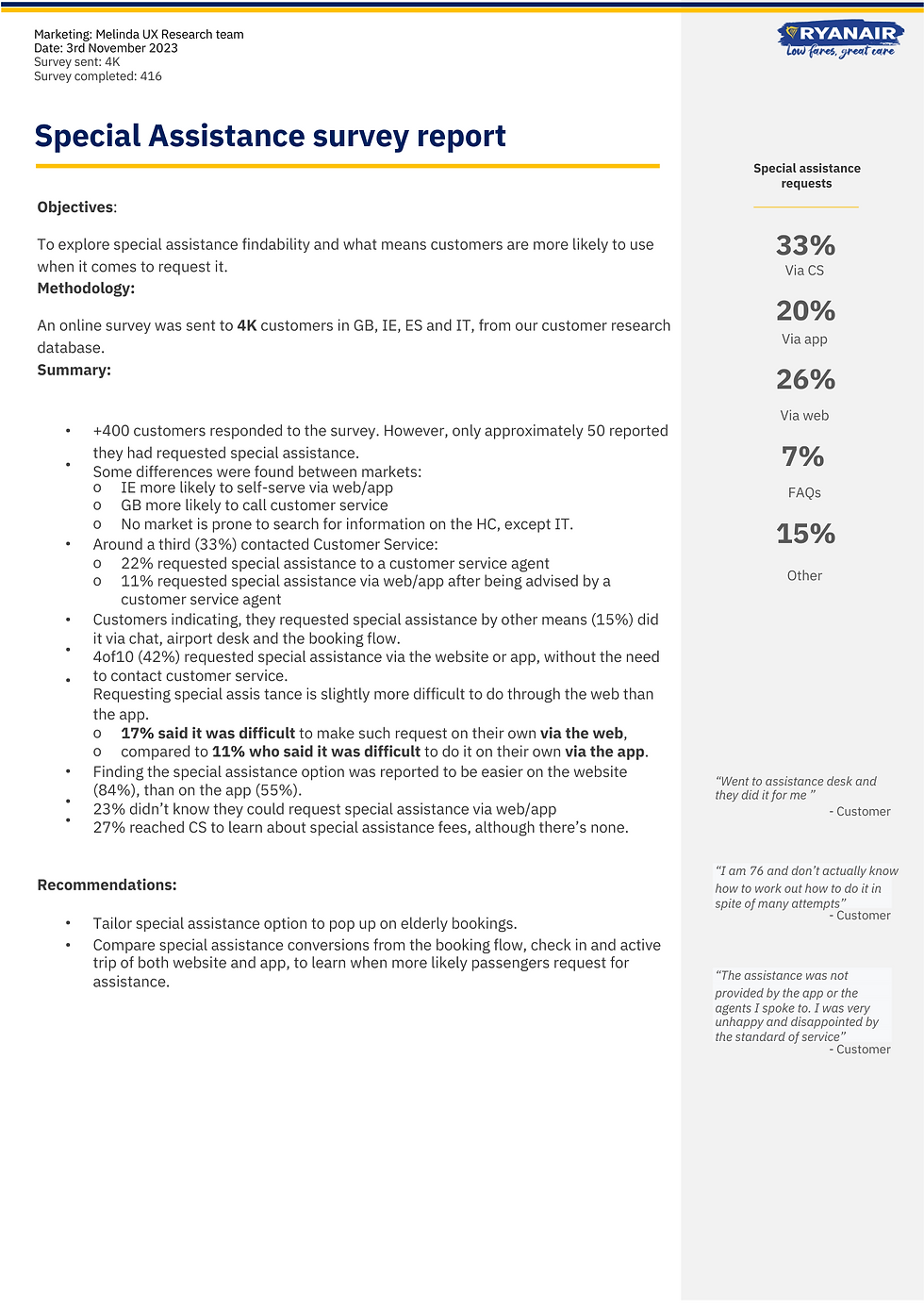
Additionally, I gathered data on customer behavior through online surveys. These surveys aimed to quantify the proportion of customers addressing specific issues via self-service options on the site, calls to the customer service center, online chat, Google searches, the app, etc.


2 - Ideate
After completing the studies, I shared the insights and recommendations with the product team in a detailed report. I then arranged a meeting to explain my findings and support my suggestions.
Once the research was well understood, I collaborated with the product team to plan a brainstorming session, aimed at generating ideas (both strategic and tactical) to solve the identified problems.

Towards the end of the session, we would vote on the most promising ideas. However, the final decision on which solutions to implement in the new design proposals was made by the Product Managers, Head of Product, and Chief Marketing Officer. The UX/UI designers then brought these ideas to life using Figma. Additionally, solutions not directly related to the product—such as Adobe campaigns, communications, and instructions for the brand team—were also considered. These were delegated to the relevant teams with a request for action plans.
The solution introduced a new concept: the Ryanair Customer Portal. This space would unify all booking management tools—both those to be developed and those that already existed—offering an enhanced and more user-friendly experience.
Access to the Customer Portal would be through Ryanair's landing page. Once a user creates an account and/or logs in, they would have access to various features for managing their booking before their flight. These include changing booking details such as name, contact email, travel documents, travel dates, origin and destination, number of passengers, passenger types, redeeming vouchers or gift card credits, and selecting types of special assistance, among other possibilities.
Additionally, the portal would introduce several new self-service options not typically available on most low-cost airlines website or apps, as observed through a competitor analysis.

These new features include gift card management, direct invoice downloads, booking history, credit management, requests for compensation, refunds, and other disruption claims. The portal would also feature a dedicated page for tracking these requests and additional options tailored for specific markets (e.g., the Erasmus student network for the Spanish market).
3 - Prototyping
This phase was led by the Product team, particularly the UX/UI designers, who created a moderately navigable prototype. This prototype was used to present progress to managers and gather feedback.
4 - Build
In this phase, the development team implemented the design proposals on our website, mobile web, or app.
5 - Analyze
To assess the performance of our newly launched designs, I relied on four primary sources of information:
Periodic reports from the CS Management Platform (Zendesk)
Google Analytics traffic data
Monthly feedback from our CSAT
User tests
Depending on the specifics of the case—such as whether there was an existing product, timelines and budget—I chose between conducting moderated or unmoderated user tests. For unmoderated tests, I used platforms like Maze, Useberry, or TryMata. For moderated tests, I shared the prototype link and conducted the sessions via Microsoft Teams or Zoom, recording the screen, camera, and voice.


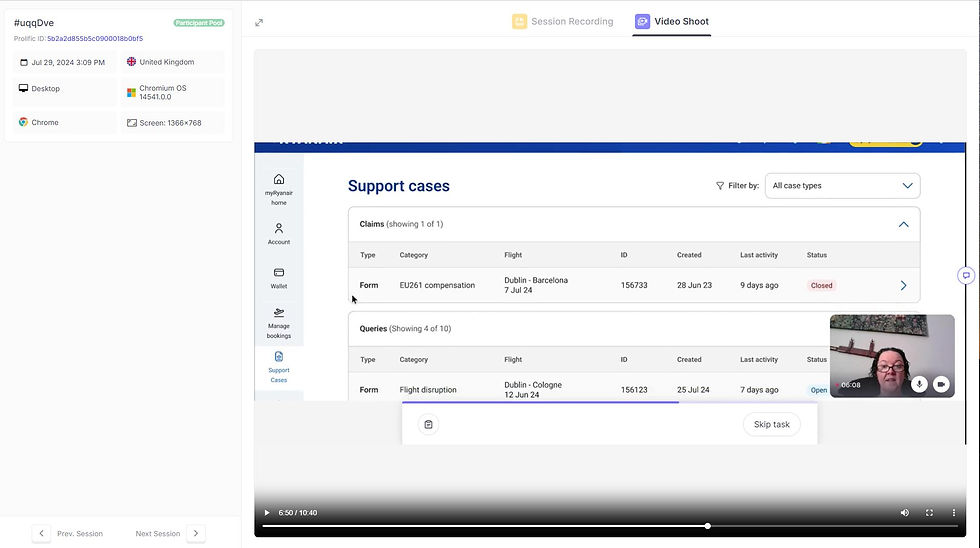

After analyzing the results, I compiled a report detailing findings and recommendations. This report aimed to address usability and accessibility issues within the interface, improve access to certain functionalities, and ensure the clarity of text and content. Ultimately, these insights were used to enhance the overall user experience.


Impact
Opening new digital communication channels between the airline and its customers, along with streamlining the management of existing functionalities, led to a 4 percentage points decrease in customer service contacts within the first month of implementation. Additionally, the rate of repeated contacts to customer service dropped by 8%.
However, customer satisfaction with managing their bookings via the web increased by only 2%. Further research revealed that, despite the ability to manage bookings online, customers were dissatisfied in some cases due to the time it took for changes to take effect. Another significant source of dissatisfaction was the presence of technical issues (bugs) on the platform.
A more detailed analysis of the impact on top drivers frequencies, showed a decrease in the number of calls related to issues such as refund requests, compensation claims, disruptions, passenger name changes, passenger type changes, flight changes, and others. Unfortunately, this information is not available in full detail.


Some of the comments obtained through the CSAT survey after the implementation of the Customer Portal:
"It’s great that I can now request a refund directly through the site, but the process wasn’t as smooth as I hoped. There was some confusion about whether my request went through."
“The portal’s new features, like managing gift cards and tracking compensation requests, are really useful. It’s great to have everything at my fingertips.”
"The self-service options are a step in the right direction, but I had to contact customer service again because the changes I made didn’t seem to go through right away."
"Being able to handle my booking changes online was fast and easy, good job."
Comments